
Technical SEO and AEO in 2026: How to Rank on Google and Get Recommended by AI
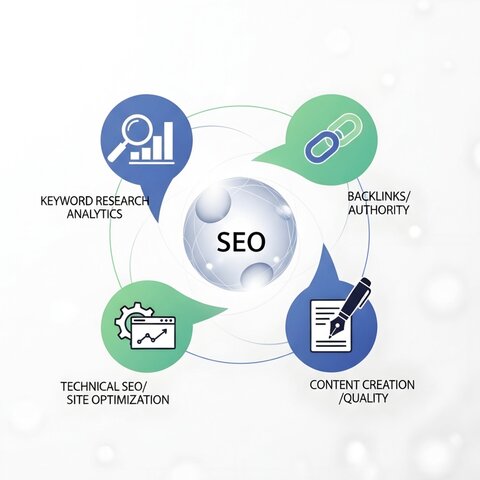
In 2026, a search-based lead generation strategy requires two systems running in parallel: technical SEO to rank on Google, and AEO (Answer Engine Optimization) to be cited by ChatGPT, Gemini, and Perplexity. This article explains how both work together, what technical differences they imply, and how Solumize implements them for businesses in Spain and Latin America.
The problem no one is telling you
You have a website. You invest in content. You rank for some keywords. And yet leads aren't arriving at the pace you expected.
The diagnosis in most cases is the same: technical SEO is incomplete, and the site isn't structured to be cited by AI. These are two distinct problems that reinforce each other when left unresolved.
In 2025, nearly 70% of Google searches ended without a single click. Users got their answer directly from the AI Overview without visiting any site. ChatGPT surpasses 1 billion weekly queries. Perplexity is growing 300% annually.
If your business doesn't appear in those answers, it's not an advertising budget problem. It's an architecture problem.
What technical SEO is and why it's still the foundation
Technical SEO is the set of configurations that allows Google to crawl, understand, and correctly index your website. Without this foundation, no other strategy works, not content, not backlinks, not AEO.
In 2026, the technical factors with the greatest impact on rankings and lead generation are:
Core Web VitalsGoogle measures load speed (LCP), visual stability (CLS), and interactivity (INP) for every page. A site that fails these metrics loses positions to faster competitors regardless of content quality. Most sites built on generic platforms have CLS and INP problems their owners don't know about.
Semantic architecture and content clustersGoogle in 2026 doesn't rank individual pages it ranks topical authority. A business with one page about "AI agent" and another about "sales automation" with no internal structure connecting them is competing with one hand tied. Content clusters, a central pillar page plus interconnected support pages, are the structure Google rewards with sustained visibility.
Clean crawlability and indexationDuplicate URLs, pages without canonical tags, misconfigured hreflang, sitemaps including thank-you pages or legal pages, these are errors that dilute Google's crawl budget and send contradictory signals. Every unresolved technical error is a position someone else is occupying.
Schema markupStructured data tells Google and LLMs exactly what you are, what you do, who is behind it, and where you are. Without Schema, you depend on the algorithm inferring it correctly. With properly implemented Schema, you control the narrative.
What AEO is and how it differs technically from SEO
AEO, or Answer Engine Optimization, is the practice of structuring content, Schema markup, and entity signals on a website so that AI platforms like ChatGPT, Gemini, Perplexity, and Google AI Overviews extract and cite it when generating responses.
The technical difference from traditional SEO is fundamental:
SEO optimizes for a ranking algorithm that evaluates relevance, authority, and technical experience to order results. AEO optimizes for language models that extract content to build answers and that prioritize clarity, specificity, structure, and verifiable authority.
In practical terms: a well-ranked Google page is not necessarily cited by ChatGPT. And content frequently cited by LLMs doesn't necessarily rank on page one. You need both.
The signals LLMs prioritize when citing a source:
- Question-and-answer format content with clear definitions
- Correctly implemented FAQ Schema
- Entity consistency: the same name, address, and description across all channels
- External authority: mentions in third-party publications, not just the brand's own site
- llms.txt: the file that tells models which pages to prioritize and how to represent the brand
- Visible EEAT: identifiable author, verifiable credentials, experience demonstrated with real data
Why combining SEO and AEO reduces cost per lead
A business that only invests in Google Ads pays for every click and stops receiving traffic the day it stops investing. A business that combines solid technical SEO with well-executed AEO builds a system that generates leads continuously with no variable cost per visit.
The impact on cost per lead is direct:
Organic search traffic converts 2 to 5 times better than display traffic because it arrives with intent. Traffic arriving from AI citations converts up to 5 times better than standard organic because it arrives with trust the user already received a recommendation before reaching your site.
A visitor who arrives because ChatGPT sent them to your website already has a lower distrust barrier. They don't need to be convinced you're legitimate. They already know.
How Solumize implements it, the real process
We don't work with templates. Every project starts with a real technical audit that analyzes the current state of the site across four dimensions: technical performance, content architecture, AEO signals, and current LLM visibility.
The process has five phases:
Phase 1 : Technical and AI visibility auditWe analyze Core Web Vitals, crawl errors, Schema status, hreflang, sitemap, and run a citation test in ChatGPT, Gemini, and Perplexity for the client's sector. The client sees exactly where they stand and what they're losing before committing to anything.
Phase 2 :Architecture and prioritizationWe design the content cluster structure, identify keywords with the highest commercial intent for the target market (Spain, Mexico, Colombia, Argentina, Chile, or Peru), and define which pages need new Schema and which need to be rewritten for LLM extraction.
Phase 3 : Technical foundation We resolve the issues blocking performance: speed, indexation, complete Schema markup (Organization, Service, FAQPage, HowTo, Author), correct hreflang, llms.txt implementation, and entity consolidation across all external channels.
Phase 4 : Dual-purpose contentWe create content designed simultaneously for Google and LLMs: it answers real questions with verifiable data, has an identified author with credentials, includes FAQ Schema, and is structured for direct extraction. Not generic content content that demonstrates first-hand experience in the client's sector.
Phase 5 : Authority and monitoringWe build the external footprint Google and LLMs need to consider a source as authority: mentions in sector publications, NAP consistency in directories, and monthly monitoring of appearances in ChatGPT, Gemini, and Perplexity responses for relevant queries.
Common mistakes that prevent technical SEO from converting into leads
After auditing websites for clinics, consultancies, law firms, and sales teams in Spain and LATAM, these are the five mistakes we find most often:
Mistake 1 : Thank-you pages indexedA form confirmation page indexed by Google signals that you have low-value content. It also appears in the sitemap and dilutes crawl budget. Fix: noindex + remove from sitemap.
Mistake 2 : Blog with hundreds of posts without hreflangIf you have EN and ES versions of your articles but don't declare hreflang in the sitemap or head, Google may index both versions as duplicate content and penalize both. It's one of the most common errors in Webflow sites with an active blog.
Mistake 3 : Schema only on the homepageMost sites implement Organization Schema on the homepage and stop there. Every service page, every blog article, and every landing page needs its own relevant Schema , Service, FAQPage, Article, Author, so Google and LLMs understand the specific context of each URL.
Mistake 4 : Missing Answer BlockLLMs extract the first clean paragraph of a page to build their responses. If that paragraph has links, bold text, lists, or formatting elements, the model discards it or misinterprets it. Every strategic page needs a clean opening paragraph, without formatting, that directly answers the page's main question.
Mistake 5 : No identifiable authorIn 2026, Google penalizes content without visible EEAT. An article without an author name, bio, and verifiable external credentials competes at a disadvantage against one signed by a real person with LinkedIn, third-party publications, and demonstrable experience.
How long does it take to produce results?
This is the real question any business asks before investing. The honest answer:
Technical fixes, speed, Schema, indexation, hreflang produce measurable results in 2 to 4 weeks. Google recrawls corrected pages and adjusts rankings relatively quickly.
Ranking improvements for competitive keywords take 3 to 6 months, depending on the domain's current authority and sector competition.
AEO citations in ChatGPT, Gemini, and Perplexity can start appearing 4 to 8 weeks after implementing FAQ Schema, llms.txt, and content structured for extraction.
The first lead attributable to organic SEO in a new project typically arrives between week 6 and week 12. In projects where organic traffic already exists and only conversion and AEO are being optimized, impact can be visible in 2 to 3 weeks.
Conclusion - The formula that works in 2026
Technical SEO without AEO leaves out 40% of search traffic that no longer passes through classic Google results. AEO without technical SEO builds on an unstable foundation LLMs prioritize sources with demonstrated authority, and that authority is built in part with technical signals.
The combination of both solid technical foundation, content structured for extraction, verifiable authority, and AI visibility monitoring is the formula that in 2026 generates qualified traffic sustainably, reduces cost per lead, and positions a brand as a reference both on Google and in the AI assistants its customers are already using.
Want to know how your site scores on these five points?
Solumize runs a free technical and AI visibility audit, we analyze your current status on Google and in LLMs and deliver a prioritized diagnosis before you spend anything.
Zero cost · Fixed price if we move forward · Spain & Latin America